What is an Open Decks night — and how to get your first slot
An Open Decks night is a night where the lineup is open. Nobody books it: the DJs claim it themselves, slot by slot. Nobody screens a demo, and nobody asks how long you have been doing this.
The venue posts the slots, and whoever takes one plays it. That makes it the shortest route from your bedroom to a real room. Here is how a night works, how to find one, and what your first set leaves behind.
What happens at an Open Decks night
The venue posts a night: a date, a slot length, and how many slots there are. That produces a public sign-up page with its own link and QR code. DJs open the page and claim a slot each.
On the night, the venue’s screen runs the order. It shows who is playing, how long they have left, and who is up next, and it moves on at the printed time. Nobody has to ask when they are on.
One thing an Open Decks night is not: an audition. There is no scoring and no winner. It is a lineup anyone can join, and that is the point — first sets happen here because nothing stands at the door.
How slots work
Every night has a public page listing each slot and which are still free. You can read it without an account, so a link from a friend works before you have signed up for anything.
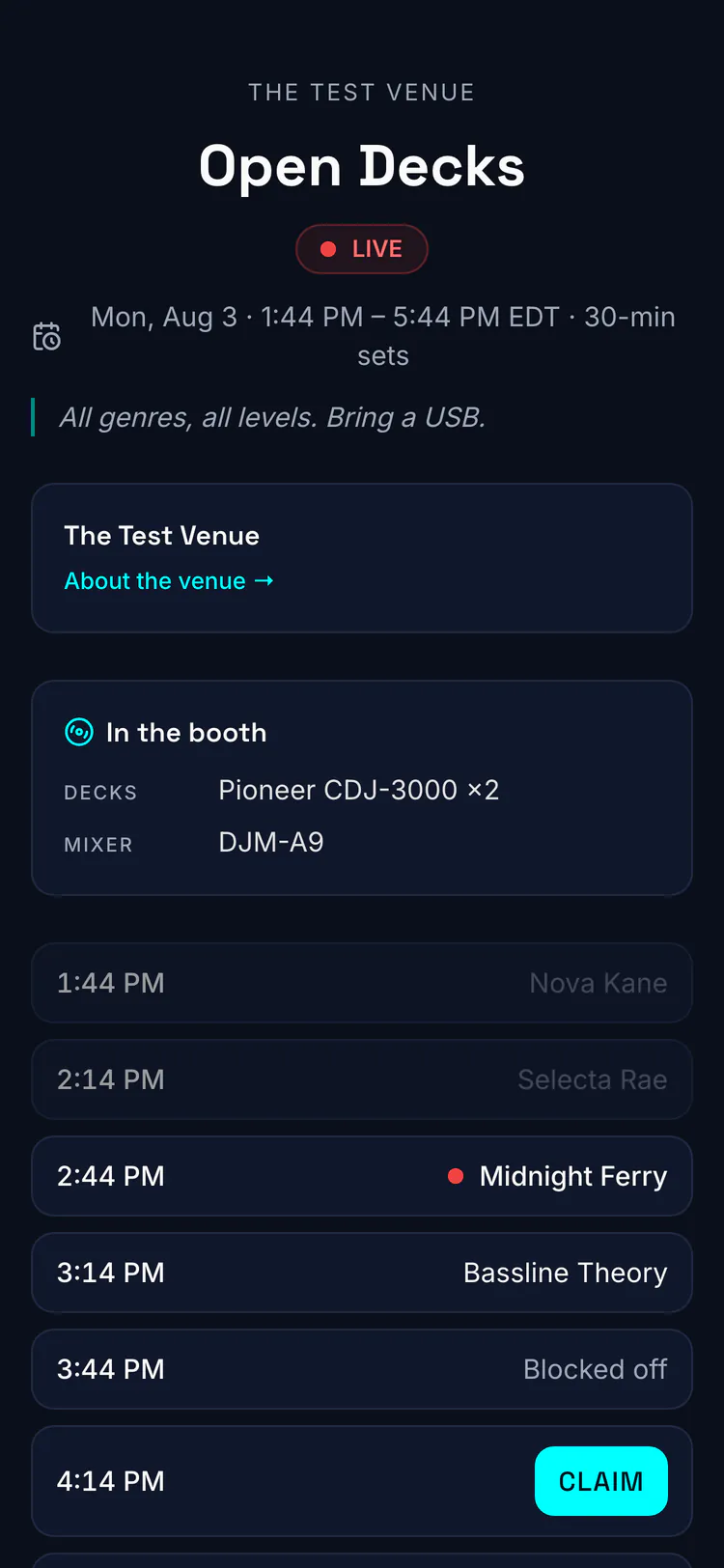
That page is the whole system: the night, the slots, and a claim button. Pick a free slot and it is yours, with your name on it.
If the night is full, join the waitlist. When a DJ drops out, everyone on the waitlist gets an email, and the first to grab the slot plays it.
If you claim a slot and cannot make it, release it from the same page as early as you can. That puts it back in the pool and tells the waitlist. Venues notice who releases early — and who never turns up at all.
How to find a night
There are three routes in. Browse the directory, which lists nights near you, city by city. Scan the code on a venue’s screen, or follow a link a venue or another DJ shared.
The screen route is worth knowing about. A venue running Open Decks leaves a sign-up code on its screen between sets, so the room watching tonight becomes next month’s lineup. If you are standing on a dancefloor wondering how to get up there, the answer is often on the wall.
Claiming your first slot
Open the night’s page and pick a slot. If you have not set up a DJ name yet, you enter one as you claim — two fields, about twenty seconds. Then check your email for the confirmation with your set time on it.
Claiming a slot is free on every plan. There is nothing to upgrade to, and no fee to the venue through us.
If you would rather arrive with your account already set up, it starts with an email address and a four-digit code. The first screen asks what you do — pick the DJ card, then give the name the crowd should call you and the city where you play.
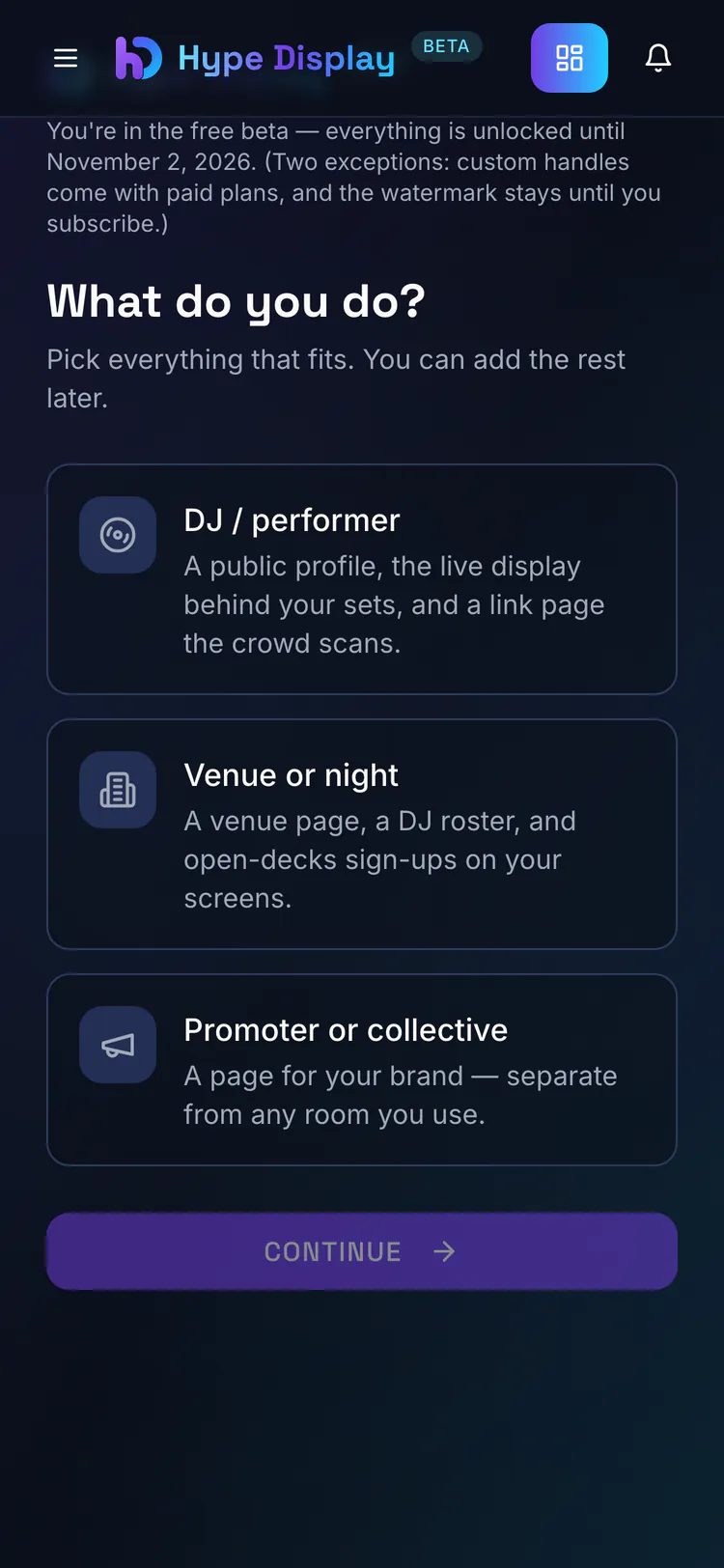
The DJ start guide walks the rest: your name on a screen, a link page, and a QR code of your own.
What to bring
Your music and your headphones. The decks are the venue’s, so ask what the booth runs if your format is unusual. Know your first track — the changeover is not the moment to browse.
Arrive at least a slot before you play, and watch the changeover ahead of yours. Changeovers are where the running order slips, and a clean handover is what the venue remembers.
While you play, a countdown shows how long you have left, so you can shape the set instead of watching a clock in your head. The at-the-gig checklist is built for gigs where you run the screen yourself — worth a read once Open Decks turns into bookings.
What you walk away with
The morning after, a recap lands in your inbox: how many people scanned from the room, what the set did for your following, and any tips you took.
Your profile records the set too. It counts under Open Decks sets played — slots you claimed and played at a venue’s night, confirmed by the venue rather than typed by you.
That is the quiet value of a first slot. Every DJ page claims experience; almost none can show a number the DJ did not choose — one played set starts yours. The measured-stats guide covers what each number counts and how to choose which appear.